About the game
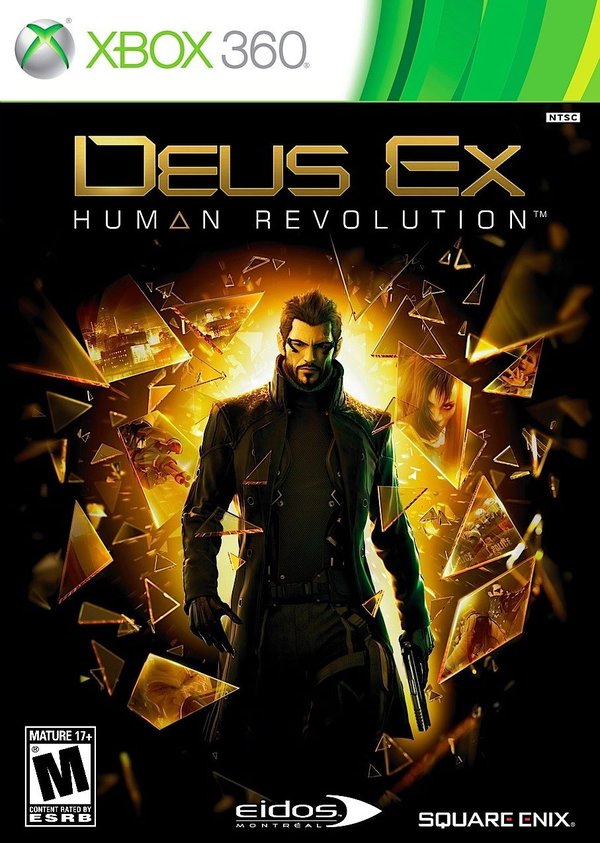
Deus Ex: Human Revolution is an action role-playing game developed by Eidos-Montréal and published by Square Enix. It is a prequel to the original Deus Ex (2000) and the third game in the series. It mixes first-person shooting, stealth and role-playing. You explore city hubs, take on quests that earn experience, and spend Praxis Kits on the abilities of the main character.
It is set in 2027. You play Adam Jensen, a security officer at Sarif Industries, a company that makes controversial artificial organs called augmentations. After an attack on Sarif, Jensen is rebuilt with extensive augmentations and sets out to find the shadowy group behind it. The story deals with transhumanism and the growing power of megacorporations.
You can shoot your way through, or stay hidden, knock guards out and move bodies out of sight. Takedowns can be lethal or non-lethal. Augmentations range from passive upgrades to active powers such as surviving long falls or lifting heavy objects. Conversations give three response choices that change how a scene ends, and hacking is a short mini-game with a time limit.
Development began in 2007 with a small team at the new Eidos-Montréal studio, after earlier attempts at a sequel at Ion Storm fell through. The key influences were the myth of Icarus and Renaissance art, which shaped the story, the black and gold look and the music. Michael McCann composed the score. The boss fights were outsourced to Grip Entertainment because the main team ran out of time.
The game came out for PlayStation 3, Windows and Xbox 360 in August 2011, with a Wii U version of the later Director's Cut in October 2013. The Xbox 360 release reached North America on August 23, 2011. In Japan it was released as plain Deus Ex on October 20, 2011, with a CERO Z rating and some cuts to violent and suggestive content. The Missing Link story episode followed on Xbox Live in October 2011.
Critics gave it acclaim for its player-driven plot and freedom of choice, with the boss fights and some technical problems drawing the most criticism. The Xbox 360 version holds a Metacritic score of 89. By November 2011 the game had sold 2.18 million copies in North America and Europe, and it was the top-selling game in North America in August 2011. A spin-off, The Fall, followed in 2013 and a direct sequel, Mankind Divided, in 2016.
The text above is adapted from Wikipedia and licensed CC BY-SA 4.0.
What critics said
Metacritic 89 out of 100 from 70 reviews (Xbox 360). Individual reviews: Eurogamer 9/10, Famitsu 36/40, Game Informer 8.5/10, GameSpot 8.5/10, IGN 9/10, Official Xbox Magazine (UK) 10/10.
Extra content
The Missing Link is a story episode that is set during the main game. Microsoft stopped selling Xbox 360 games and add-ons on 29 July 2024. Add-ons you already own can be downloaded again from your download history. The Director's Cut released in 2013 has The Missing Link built in.
- The Missing Link: A story episode set during the main game, in which Adam is captured and stripped of his augmentations. Two achievements, Factory Zero and Never Stop Looking, belong to it. It came to Xbox Live in Japan on 2012-03-20.
Good to know
- The boss fights were made by Grip Entertainment, because the main team ran out of time. The later Director's Cut reworked the boss arenas.
- In Japan the game was released as plain Deus Ex, on 20 October 2011, with a CERO Z rating and cuts to violent and suggestive content.
- The Director's Cut of 2013 is a separate release with The Missing Link built in, developer commentary and a documentary, and on Xbox 360 it used Xbox SmartGlass as a second screen.
- 33 of the 59 achievements are secret, including all the boss fights and most of the conversation ones.
- In the UK the game sold nearly a million copies in its first week, with Xbox 360 making up 57 percent of sales.
- A GameStop promotion offered free OnLive access, but the coupon was removed from the packaging.
Made by
Director Jean-François Dugas, Producer David Anfossi, Writer and narrative director Mary DeMarle, Lead designer François Lapikas, Art director Jonathan Jacques-Belletête, Composer Michael McCann.